
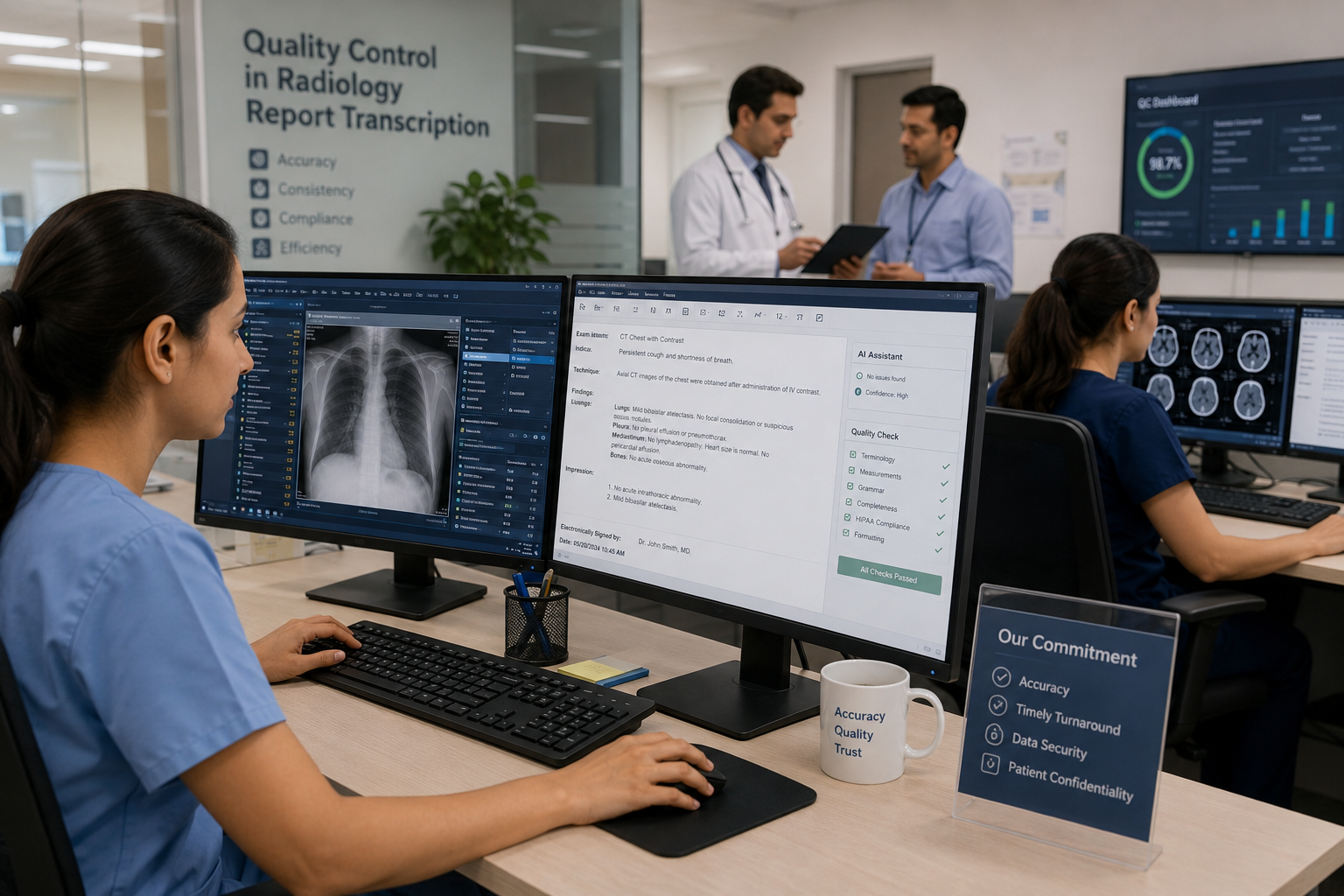
Accurate medical documentation is the backbone of modern healthcare. In radiology departments, every imaging report carries critical information that influences diagnosis, treatment planning, and patient outcomes. This is why Quality Control in Radiology Report Transcription has become an essential part of healthcare documentation processes. Hospitals, diagnostic centers, and imaging facilities rely heavily on accurate transcription services to maintain compliance, improve workflow efficiency, and reduce clinical errors.
A professionally managed Radiology Report Transcription process ensures that radiologists’ findings are converted into clear, precise, and well-structured reports. Even a small transcription error can lead to misinterpretation, delayed treatment, or legal complications. Therefore, healthcare providers increasingly partner with experienced Radiology Transcription Services providers to maintain the highest quality standards.
In today’s fast-paced healthcare environment, maintaining quality is not just about correcting spelling mistakes. It involves multiple layers of review, standardized reporting practices, advanced technology integration, and strict compliance monitoring. A trusted Radiology Transcription Company can significantly improve report accuracy while supporting seamless Radiology Workflow Documentation.
Radiology reports contain detailed observations from imaging studies such as:
These reports directly affect patient diagnosis and physician decision-making. Poor-quality transcription can create confusion and affect treatment outcomes. This makes quality control a mandatory process in radiology documentation.
| Quality Factor | Importance in Radiology Transcription |
|---|---|
| Accuracy | Prevents diagnostic misunderstandings |
| Compliance | Maintains HIPAA and healthcare regulations |
| Faster Reporting | Improves turnaround time |
| Standardization | Ensures consistency in reports |
| Reduced Errors | Minimizes legal and clinical risks |
| Better Workflow | Enhances departmental productivity |
An effective quality control system helps healthcare organizations maintain professional reporting standards while improving operational efficiency.
A robust quality assurance process includes multiple checkpoints to verify report accuracy and completeness.
Professional transcriptionists with radiology specialization understand complex medical terminology, anatomy, imaging procedures, and abbreviations. Their expertise reduces interpretation errors and ensures reliable documentation.
Specialized Radiology Transcription Services often employ trained experts who understand various imaging modalities and radiology workflows.
Most high-quality transcription providers use a multi-step review process:
This layered approach improves accuracy and consistency.
Templates ensure uniformity across reports. Standard formats help radiologists and physicians quickly locate critical findings, impressions, and recommendations.
Templates also improve Radiology Workflow Documentation by streamlining documentation procedures.
Many healthcare organizations use speech recognition software for report generation. However, AI-generated text can contain inaccuracies. Human quality reviewers are essential for correcting contextual and terminology-related mistakes.
HIPAA compliance and patient confidentiality are critical in medical documentation. A reliable Radiology Transcription Company implements secure workflows, encrypted file transfers, and access-controlled systems to maintain data privacy.
Even experienced professionals can encounter challenges in radiology documentation. Quality control processes help identify and eliminate common transcription issues.
Common Mistakes Include:
For example, confusing “left” and “right” in imaging reports can create serious clinical consequences. Quality assurance reviewers carefully verify all details before report submission.
Technology has transformed the medical transcription industry. Advanced software tools now support better documentation accuracy and workflow management.
Technologies Used in Modern Radiology Transcription
| Technology | Benefits |
|---|---|
| Speech Recognition | Faster report creation |
| AI-Powered Editing | Error detection assistance |
| Secure Cloud Platforms | Safe data storage |
| EHR Integration | Seamless report transfer |
| Automated Quality Checks | Improved consistency |
| Digital Templates | Standardized formatting |
Although automation improves efficiency, human oversight remains essential for maintaining report quality.
Proper workflow documentation helps with:
A streamlined workflow also reduces physician burnout by minimizing documentation burdens.
Many healthcare organizations outsource transcription tasks to specialized providers. A professional Radiology Transcription Company offers several advantages.
Specialists ensure high-quality reporting standards.
Reports are delivered quickly for timely care.
Reduces infrastructure and staffing costs.
Round-the-clock transcription services.
Organizations can manage fluctuating report volumes efficiently.
Professional vendors maintain strict security and compliance standards.
Healthcare facilities that outsource transcription often experience improved productivity and better documentation consistency.
To maintain high standards, healthcare organizations should implement structured quality assurance procedures.
Best Practices Include:
Routine quality audits help identify recurring transcription errors and training needs.
Radiology-focused professionals understand imaging terminology better than general transcriptionists.
Radiologists should use clear, structured dictation methods to reduce ambiguities.
Collaborative review systems improve report consistency and learning opportunities.
Ongoing education ensures transcriptionists stay updated with evolving medical terminology and technology.
Despite technological advancements, maintaining consistent quality can still be challenging.
Despite technological advancements, maintaining consistent quality can still be challenging.
Common Challenges:
A dedicated quality management system helps organizations overcome these issues effectively.
Pro Tip: Choose a Radiology Transcription Company that combines AI-powered transcription tools with experienced human editors. Technology improves speed, but expert human review ensures clinical accuracy and compliance.
The future of radiology documentation is becoming increasingly technology-driven. However, quality assurance will continue to play a vital role.
Emerging Trends:
Even with advanced automation, healthcare providers will continue to rely on professional quality reviewers for accurate clinical reporting.
Quality control in Radiology Report Transcription is essential for maintaining accurate patient records, improving physician communication, and supporting better healthcare outcomes. High-quality transcription processes reduce errors, improve turnaround times, and enhance overall operational efficiency.
Professional Radiology Transcription Services help healthcare organizations maintain consistent documentation standards while ensuring compliance with industry regulations. By partnering with an experienced Radiology Transcription Company, hospitals and diagnostic centers can strengthen their Radiology Workflow Documentation and deliver better patient care.
As healthcare technology continues to evolve, combining automation with expert human quality assurance will remain the most effective strategy for achieving reliable and accurate radiology reporting.
Radiology Report Transcription is the process of converting dictated radiology findings into accurate written medical reports for healthcare documentation.
Quality control ensures report accuracy, reduces medical errors, improves compliance, and supports better patient care outcomes.
They streamline report documentation, reduce turnaround times, improve communication, and support efficient Radiology Workflow Documentation.
Look for experience, HIPAA compliance, quality assurance processes, fast turnaround times, and skilled radiology transcription specialists.
AI improves efficiency, but human transcriptionists are still necessary for contextual accuracy, medical terminology verification, and quality control.